

When a storm rolls through Central Texas, the roof does more than keep you dry. It gathers an enormous amount of water in a very short time. Most of the time that water rushes into a gutter, down a downspout and out into the yard. But how much is it, really? A little arithmetic gives a surprising answer, and it shows why the gutter system deserves more attention than it usually gets.
If you are planning gutter installation in Autin, the numbers in this article will help you think about size, placement and what you want to do with the water. Let us start with the math.
The Number to Remember: 0.62
Texas A&M AgriLife Extension’s beginners guide to harvesting rainwater gives a simple rule. Each inch of rain yields about 0.62 gallons for every square foot of roof. That one number lets you estimate how much water your home sheds in any storm.
A Worked Example
The AgriLife guide offers an example: a 1,000 square foot roof produces about 620 gallons from 1 inch of rain. Using the same rule, here is how the figures grow with the size of the roof.
- 1,000 square feet of roof, 1 inch of rain: about 620 gallons.
- 1,500 square feet of roof, 1 inch of rain: about 930 gallons.
- 2,000 square feet of roof, 1 inch of rain: about 1,240 gallons.
- 1,000 square feet of roof, half an inch of rain: about 310 gallons.
The last three lines are my own arithmetic using the AgriLife rule, so treat them as estimates. Real roofs have slopes, overhangs and losses, and the exact figure will vary.
Where All That Water Goes
A roof that sheds hundreds of gallons in a single downpour needs a path for the water. That is the job of the gutter and downspout. If gutters are undersized, clogged or poorly pitched, water spills over the edge and lands beside the foundation, where it can cause trouble. This is general home-care knowledge, not part of the AgriLife guide.
For a sense of what is available, the company behind this article’s link lists seamless aluminum gutters in 5, 6 and 7 inch sizes, fabricated on site, along with leaf guards, custom downspout solutions and gutter cleaning and maintenance. Its website says it serves Austin and other Central Texas cities.
What You Need to Catch It
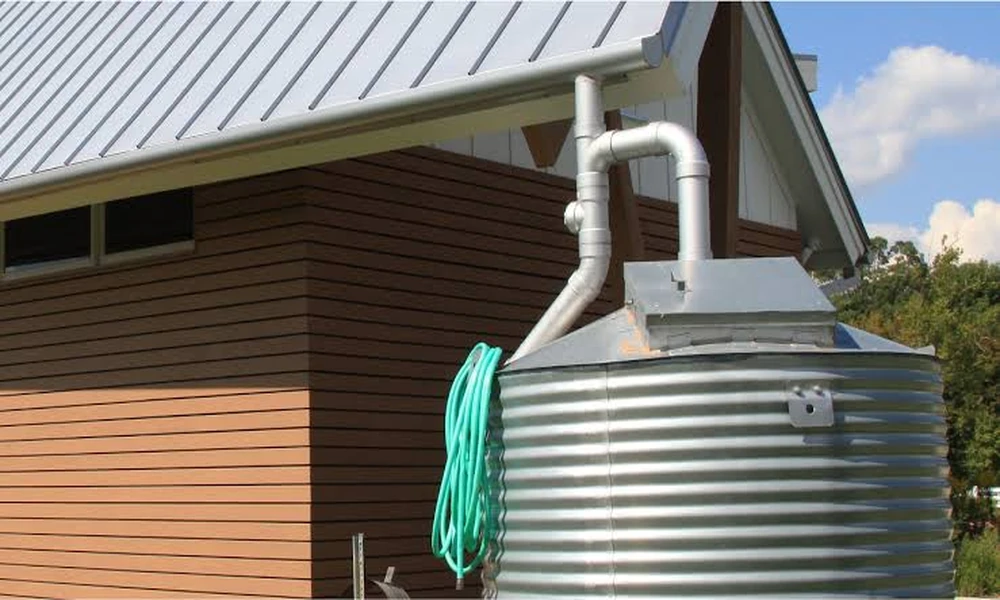
The AgriLife guide lists four basics for anyone who wants to use roof water: a collection surface, ideally a roof; a way to direct the water, such as a rain gutter and downspout; a storage container such as a rain barrel, a food-grade barrel or a large clean trash can; and a path to the container, such as a pipe, PVC tube or rain chain.
The guide also says you do not always need a gutter, if you can find the roof’s lowest point or valley where the rain runs off naturally. Still, for most homes a gutter is the neatest way to collect the water in one place.
Why Dry Spells Make Harvesting Worth It
One of the guide’s main points is that infrequent rain is the reason to harvest, not a reason to skip it. Stored rainwater helps plants survive dry periods and lets people keep gardening during drought. The guide quotes an AgriLife horticulturist saying that much of Texas has been in drought.
Safety and Maintenance
The guide is clear that harvested rainwater is grey water. It suits plants and washing cars, but it should not be consumed by people or pets. A system meant for drinking water needs more advanced equipment and expert advice.
It also advises keeping stored water free of mosquitoes and using a filter to catch leaves and debris. Clean gutters make that second job much easier, since less debris reaches the barrel.
Questions to Ask Before Installing Gutters
- How big is my roof, and how much water will it shed in a heavy rain?
- What gutter size suits that volume?
- Where should the downspouts empty?
- Do I want leaf guards to cut down on debris?
- Do I want to capture water, and where will a barrel sit?
- What does the estimate include?
The Takeaway
Your roof is a water collector whether you plan for it or not. A little math turns that into useful knowledge, and good gutters turn it into a tool, whether you simply want to protect your foundation or capture water for the garden.